Every merge to master quietly breaks other PRs. So I built a radar for it.
Subtitle: A merge to master is a tiny earthquake that nobody feels until later. Two workflows detect the damage immediately — and tell the right people.
The Self-Driving Repo · Part 4 — Conflict Management
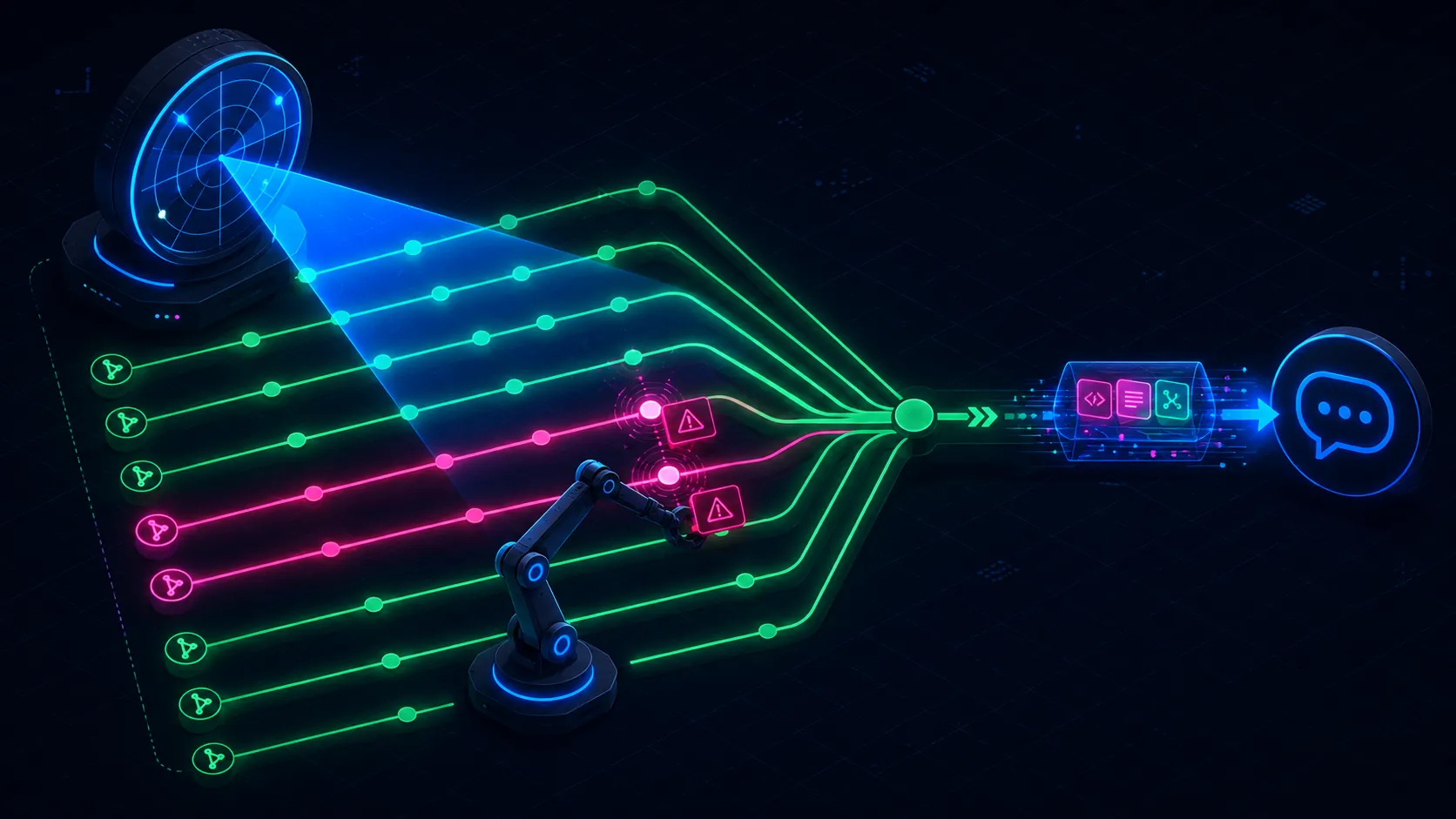
Here's a failure mode so normal you've stopped noticing it: you merge a PR to master, and in that instant some number of other open PRs become un-mergeable. They were fine a second ago. Now they conflict. But nobody knows yet — the authors are working on something else, and they'll find out hours or days later when they try to merge and GitHub says no.
Multiply that by a busy master and a dozen open PRs and you get a slow, invisible tax: branches drifting out of sync, conflicts discovered at the worst possible moment (merge time), and a steady drip of "can you rebase?" comments.
I wanted the opposite: the moment master moves, every open PR gets refreshed against it, and anything that conflicts gets flagged and announced — immediately, while the change is still fresh in everyone's head.
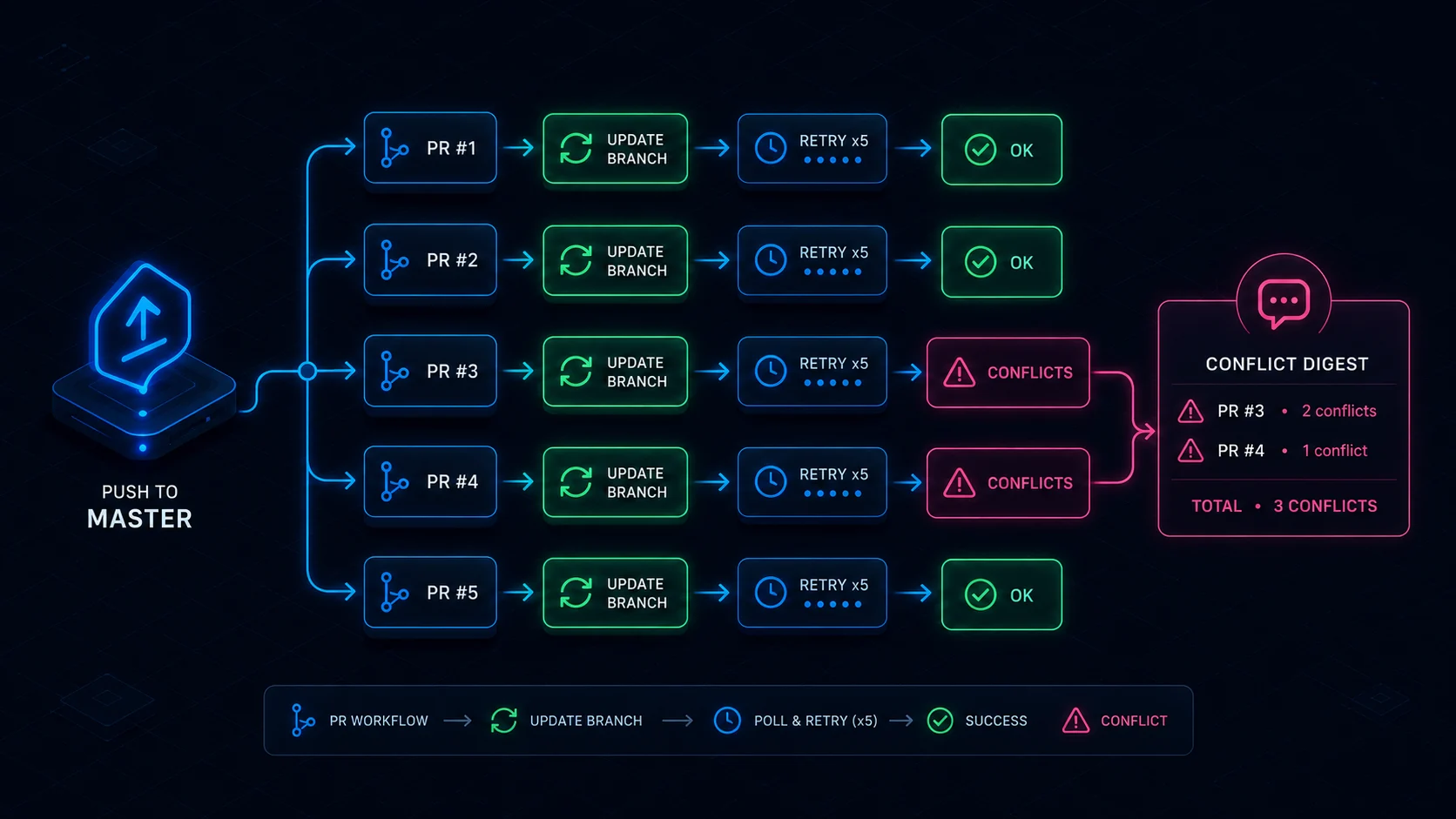
Auto-detecting merge conflicts across open PRs is a two-workflow GitHub Actions system: a sweep and a broadcast. The sweep triggers on every push to master, paginates through all open PRs with github.rest.pulls.list, and calls github.rest.pulls.updateBranch on each (the API equivalent of GitHub's "Update branch" button), skipping forks and treating a 422 as "nothing to do" rather than a failure. Because GitHub computes mergeability asynchronously, you must treat mergeable as eventually consistent: poll pulls.get with backoff (up to 5 retries, 2s apart) until it stops returning null, then reconcile a conflict label based on mergeable === false or mergeable_state === 'dirty'. The broadcast workflow reads conflict-labeled PRs, builds an author→PRs map, translates each GitHub login to a chat handle, and posts one grouped Discord digest—push-based, grouped, and routed—so each conflict reaches the right author within seconds, not days after it has already broken their branch.
The problem
Three things were going wrong, all downstream of the same root cause (master moves, PRs don't):
1. Stale branches. PRs fall behind master and their CI results stop meaning anything — they passed against an old base. 2. Late conflict discovery. Authors learn about conflicts when they try to merge, which is the most disruptive possible time. 3. Notification fatigue. GitHub can tell you a PR is conflicted, but it's buried in a UI nobody watches. The signal never reaches the person who needs it.
The idea
Two workflows working as a pair:
- The sweep — triggered on every push to
master. Walk every open PR, update its branch against the newmaster, then check whether it now conflicts and label it accordingly. - The broadcast — takes the conflicted PRs and posts a digest to team chat, grouped by author, so each person sees exactly their PRs that need attention.
Detection and notification are deliberately separate. The sweep maintains accurate state (labels on PRs). The broadcast turns that state into a message. Splitting them means I can re-run or reschedule the announcement without re-running the (heavier) sweep.
How do you auto-detect merge conflicts on every push to master?
Refresh everything on every merge
The sweep triggers on push to master and pages through all open PRs against it:
on:
  push:
    branches: [master]
const prs = await github.paginate(github.rest.pulls.list, {
owner, repo, state: 'open', base: 'master', per_page: 100,
});For each one, it asks GitHub to update the branch (the same "Update branch" button you click by hand, as an API call), skipping forks where you don't have permission:
if (!(pr.head?.repo?.fork && !pr.maintainer_can_modify)) {
  try {
    await github.rest.pulls.updateBranch({ owner, repo, pull_number: pr.number });
  } catch (e) {
    if (e.status === 422) { /* conflict or already up to date — skip */ }
    else if (e.status === 403) { /* no permission — skip */ }
  }
}
The 422 handling is the bit you only learn by getting burned: updateBranch throws 422 both when the branch can't be fast-forwarded (a real conflict) and in benign "nothing to do" cases. You don't treat it as failure — you treat it as "move on and let the mergeability check below tell the truth."
Wait for GitHub to make up its mind
Here's the trap that makes naive versions of this flaky. When you ask GitHub whether a PR is mergeable, the answer is often null — "I haven't computed that yet, check back." Read it too early and you'll mislabel a perfectly clean PR as conflicted.
So you poll, with backoff, until the state settles:
let pr = await github.rest.pulls.get({ owner, repo, pull_number });
for (let i = 0; i < 5 && pr.data.mergeable === null; i++) {
  await new Promise(r => setTimeout(r, 2000));   // let GitHub compute
  pr = await github.rest.pulls.get({ owner, repo, pull_number });
}
const hasConflicts =
  pr.data.mergeable === false || pr.data.mergeable_state === 'dirty';
Treating mergeable as eventually consistent rather than a synchronous value is the single most important thing in this workflow. Everything else is bookkeeping.
Then the label is reconciled — added if conflicting, removed if not — so the conflict label always reflects the live state:
if (hasConflicts && !hasLabel)      await addLabel('conflict');
else if (!hasConflicts && hasLabel) await removeLabel('conflict');
Turn state into a message people see
The broadcast workflow reads the conflict-labeled PRs and builds an author → PRs map, then posts one grouped digest to team chat:
const map = {};                       // author -> [pr urls]
for (const pr of conflictedPRs) {
  (map[pr.user.login] ??= []).push(pr.html_url);
}
Each GitHub author is translated to their chat handle so the message actually pings the right human, and a clean run gets a cheerful "no conflicts 🎉" instead of awkward silence. It also runs on a daily schedule, not just on demand — so even conflicts that appear through other paths get a regular nudge.
The reason this lands where GitHub's own notifications don't: it's push-based, grouped, and routed. It arrives in the tool the team already lives in, addressed to the person who can fix it, listing exactly their PRs. No dashboard to remember to check.
What does automatic conflict detection actually improve?
- Conflicts surface in seconds, not days — right after the merge that caused them, while context is fresh.
- PR branches stay current, so green CI actually means "green against today's
master." - The right person gets pinged, in chat, with their specific PRs — around 10 fewer manual "please rebase" comments a week.
- Less merge-time drama. By the time you go to merge, you already knew (and probably already fixed) the conflict.
Gotchas & trade-offs
- Auto-updating branches re-triggers CI. Refresh 20 PRs and you just queued 20 CI runs. Usually worth it (fresh results), but mind your runner minutes — you may want to scope which PRs get swept.
- Forks need permission.
updateBranchonly works where "maintainers can edit" is on; the workflow skips the rest rather than erroring. Know that some PRs won't be auto-refreshed. 422is overloaded. It means both "real conflict" and "nothing to update." Don't treat it as a failure signal — let the mergeability poll be your source of truth.- Chat handle mapping is manual. A GitHub-login → chat-ID table has to be maintained as people join and leave. It's the kind of small debt that silently breaks pings.
- Don't over-notify. A conflict digest every hour becomes wallpaper. Daily + on-merge was the right dose; tune it to your team's tolerance.
Related reading
This article is part of The Self-Driving Repo series. The radar tells you that a PR conflicts — the rest of the cluster decides what to do about it:
- Letting a bot resolve merge conflicts safely — the one provably-safe case where a GitHub Action can auto-commit a conflict fix to a contributor's branch.
- Automated stale branch cleanup — deleting dead branches in bulk without deleting the wrong one: classify, cap, defer, audit.
From the Flutter Reference:
- GitHub Actions vs Codemagic compared — whether this workflow stays on Actions or moves to a mobile-native CI.
- Best Flutter CI/CD tools — the wider automation toolchain these workflows live in.
Takeaway
A merge to master has a blast radius, and the cheapest time to deal with that radius is immediately. Refresh every PR on every merge, treat mergeability as eventually consistent (poll it, don't trust the first read), and route the result to a human in the tool they already watch. Detect fast; notify where people actually look.
Next: the flagship. What if, for one common class of conflict, the repo didn't just detect it — it fixed it and pushed the resolution for you?
The complete workflow
Here is the full, genericized workflow — drop it into .github/workflows/ and replace the placeholders (your-org, the PROJ project key, <@DISCORD_USER_ID>, the example team, and the secret names) with your own.
.github/workflows/update_all_prs_and_sweep.yml
name: Update PR branches and sweep conflict on master push
on:
  push:
    branches: [master]

permissions:
  contents: write
  pull-requests: write
  issues: write

jobs:
  update-all-prs-and-sweep:
    runs-on: ubuntu-slim
    steps:
      - uses: actions/github-script@v7
        with:
          script: |
            const owner = context.repo.owner;
            const repo = context.repo.repo;
            const base = context.ref.replace('refs/heads/', '');
            const labelName = 'conflict';

            // Ensure conflict label exists
            try { await github.rest.issues.getLabel({ owner, repo, name: labelName }); }
            catch (e) { if (e.status === 404) await github.rest.issues.createLabel({ owner, repo, name: labelName, color: 'd73a4a' }); else throw e; }

            const prs = await github.paginate(github.rest.pulls.list, { owner, repo, state: 'open', base, per_page: 100 });

            for (const p of prs) {
              // Step 1: Try to update PR branch with latest master
              if (!(p.head?.repo?.fork && !p.maintainer_can_modify)) {
                try {
                  await github.rest.pulls.updateBranch({ owner, repo, pull_number: p.number });
                  console.log(`Updated PR #${p.number}`);
                } catch (e) {
                  const status = e.status || e.response?.status;
                  if (status === 422) {
                    console.log(`Skipped updating PR #${p.number} due to conflicts or not behind`);
                  } else if (status === 403) {
                    console.log(`Skipped updating PR #${p.number} due to permissions`);
                  } else {
                    console.log(`Error updating PR #${p.number}: ${e.message}`);
                  }
                }
              } else {
                console.log(`Skipped PR #${p.number} from fork because maintainer edits are not allowed`);
              }

              // Step 2: Check for conflicts and manage label
              let pr = await github.rest.pulls.get({ owner, repo, pull_number: p.number });
              // If mergeable is null/unknown, wait briefly and retry
              for (let i = 0; i < 5 && (pr.data.mergeable === null || (pr.data.mergeable_state||'').toLowerCase() === 'unknown'); i++) {
                await new Promise(r => setTimeout(r, 2000));
                pr = await github.rest.pulls.get({ owner, repo, pull_number: p.number });
              }
              const hasConflicts = (pr.data.mergeable === false) || ((pr.data.mergeable_state||'').toLowerCase() === 'dirty');

              const { data: labels } = await github.rest.issues.listLabelsOnIssue({ owner, repo, issue_number: p.number, per_page: 100 });
              const hasLabel = labels.some(l => l.name.toLowerCase() === labelName);

              if (hasConflicts && !hasLabel) {
                await github.rest.issues.addLabels({ owner, repo, issue_number: p.number, labels: [labelName] });
                console.log(`Added conflict label to PR #${p.number}`);
              } else if (!hasConflicts && hasLabel) {
                await github.rest.issues.removeLabel({ owner, repo, issue_number: p.number, name: labelName });
                console.log(`Removed conflict label from PR #${p.number}`);
              }
            }
.github/workflows/conflict-notify.yml
name: List open PR authors (conflict label → map, URLs only)
on:
  workflow_dispatch:
    inputs:
      label:
        description: 'Label to filter PRs by'
        required: false
        default: 'conflict'
  schedule:
    - cron: '0 0 * * *' # daily at midnight UTC (optional)

permissions:
  contents: read
  pull-requests: read

jobs:
  list-authors:
    runs-on: ubuntu-slim
    steps:
      - name: List open PRs with label and build author→PR-URL map
        id: list_prs
        uses: actions/github-script@v6
        with:
          script: |
            const fs = require('fs');

            const owner = context.repo.owner;
            const repo = context.repo.repo;
            const targetLabel = core.getInput('label') || 'conflict';
            core.info(`Listing open PRs for ${owner}/${repo} and filtering by label "${targetLabel}"`);

            // Fetch all open PRs (handles pagination)
            const pulls = await github.paginate(github.rest.pulls.list, {
              owner,
              repo,
              state: 'open',
              per_page: 100,
            });

            core.info(`Found ${pulls.length} open PR(s)`);

            // Filter PRs that contain the target label (case-insensitive)
            const filtered = pulls.filter(p => {
              const labels = p.labels || [];
              return labels.some(l => String(l.name).toLowerCase() === String(targetLabel).toLowerCase());
            });

            core.info(`Found ${filtered.length} open PR(s) with label "${targetLabel}"`);

            // Build mapping: author -> [ "https://github.com/owner/repo/pull/NNN", ... ]
            const map = {};
            for (const p of filtered) {
              const author = p.user?.login || 'unknown';
              if (!map[author]) map[author] = [];

              const httpsUrl = p.html_url;
              // Add only the full https URL, avoid alternate @owner/repo style
              if (!map[author].includes(httpsUrl)) map[author].push(httpsUrl);
            }

            core.setOutput('mapping', JSON.stringify(map));
            core.setOutput('filtered_pr_count', String(filtered.length));
            core.setOutput('authors', JSON.stringify(Object.keys(map)));

      - name: Print mapping to job log
        run: |
          echo "Mapping (author -> [PR URLs]):"
          echo '${{ steps.list_prs.outputs.mapping }}'

      - name: Format Discord message
        id: format_message
        uses: actions/github-script@v6
        with:
          script: |
            const mapping = JSON.parse('${{ steps.list_prs.outputs.mapping }}');
            const prCount = parseInt('${{ steps.list_prs.outputs.filtered_pr_count }}');

            // GitHub username to Discord user ID mapping
            const discordMapping = {
              'jpark': '<@DISCORD_USER_ID>',
              'ckim': '<@DISCORD_USER_ID>',
              'your-maintainer': '<@DISCORD_USER_ID>',
              'rdiaz': '<@DISCORD_USER_ID>',
              'schen': '<@DISCORD_USER_ID>'
            };

            if (prCount === 0) {
              core.setOutput('message', 'No open PRs with conflicts found! 🎉');
              return;
            }

            let message = '⚠️ **Please solve conflicts**\n\n';

            for (const [author, urls] of Object.entries(mapping)) {
              const discordMention = discordMapping[author] || author;
              message += `**${discordMention}**\n`;
              for (const url of urls) {
                message += `${url}\n`;
              }
              message += '\n';
            }

            message += '----------------------------------';

            core.setOutput('message', message.trim());

      - name: Discord Webhook Action
        uses: tsickert/discord-webhook@v6.0.0
        with:
          webhook-url: ${{ secrets.DISCORD_WEBHOOK_URL }}
          content: ${{ steps.format_message.outputs.message }}