I let a bot resolve merge conflicts and push the fix. Here's how I made that safe.
Subtitle: Auto-committing to other people's branches is terrifying — until you shrink the blast radius to one provably-safe case. This is that story.
The Self-Driving Repo · Part 5 — Conflict Management (flagship)
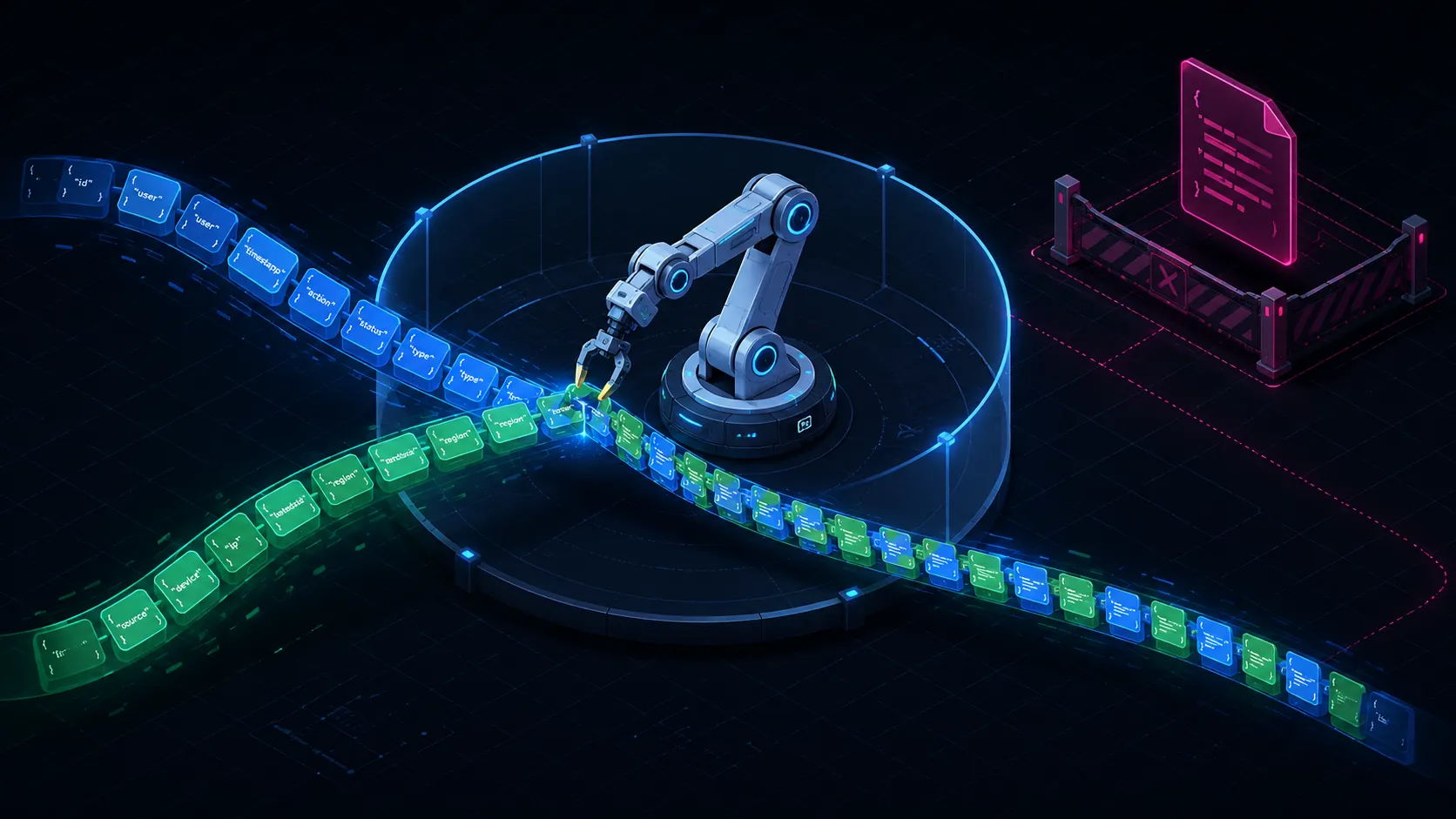
Let me start with the version of this idea that should scare you:
"What if a GitHub Action automatically resolved merge conflicts and force-pushed the result to people's PR branches?"
If your stomach dropped, good — mine did too. A bot that runs git merge and git push against branches it doesn't own is exactly how you corrupt someone's work, lose a commit, or merge two versions of a file into nonsense. This is the most dangerous automation in the entire series.
And yet it runs on every push to master, it resolves real conflicts, and I trust it. The trick wasn't writing a smarter merge algorithm. It was making the bot profoundly cowardly — it only acts in one narrow situation where the "right answer" is mechanical and provable, and it runs away from everything else.
This post is about how to take a scary capability and make it safe by aggressively shrinking its blast radius.
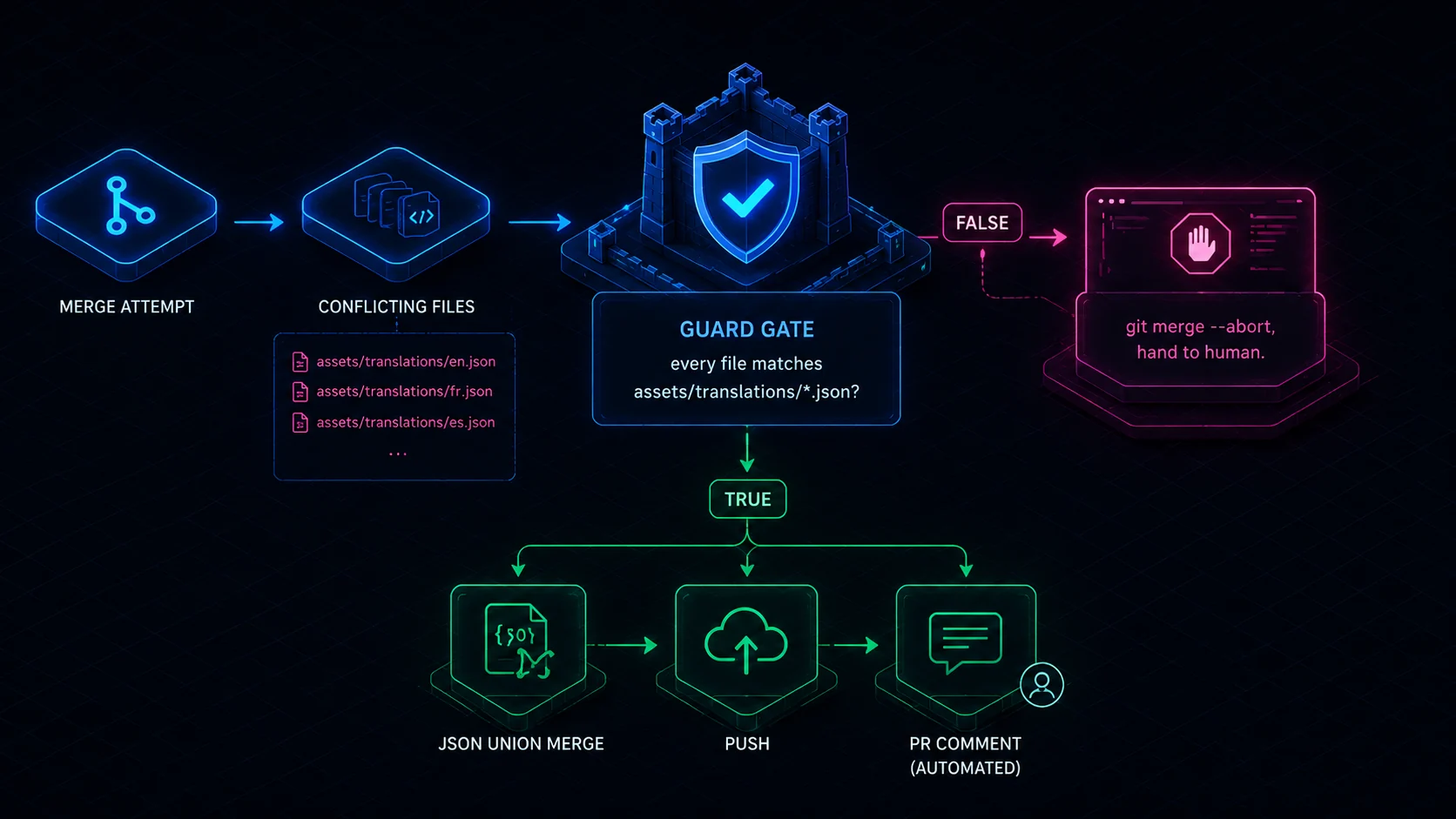
A GitHub Action that auto-resolves merge conflicts is made safe by shrinking its blast radius to one provably-safe case. This bot runs actions/github-script on every push to master, and only resolves conflicts when every unmerged file matches the regex /^assets\/translations\/.*\.json$/. If even one .dart or pubspec.yaml file conflicts, it calls git merge --abort and hands the PR to a human. It also skips drafts and forks, and waits out GitHub's eventually-consistent mergeable field before touching anything. Here's how it works: it merges in a throwaway _auto_resolve branch, parses each translation file's clean versions from both sides with git show, and unions the JSON key sets ({ ...masterJSON, ...branchJSON })—branch wins on true collisions. It then pushes the fix, comments listing the files touched, and says "please review." Any unexpected error fails closed via git merge --abort. The safety lives in the refusal logic, not the merge algorithm: dumb-and-provable beats smart-and-probabilistic.
Why do translation JSON files conflict on every PR?
We ship in multiple languages. Translations live in per-locale JSON files — assets/translations/en.json, ar.json, and so on. Add a feature and you add keys to all of them. Which means every feature branch touches the same translation files, and they conflict constantly.
But here's the thing: these conflicts are almost never real. Two developers add different keys to en.json. Git sees edits to the same region and throws up its hands. A human opens the file, looks at the two sides, and realizes there's nothing to decide — you want both keys. It's the dumbest possible conflict, and resolving it by hand is pure tax: it blocks the PR, interrupts the author, and contributes exactly zero thought.
Code conflicts deserve a human. Two people adding "save_button": "Save" and "share_button": "Share" to the same JSON do not.
The idea: automate the mechanical case, refuse everything else
The workflow runs on every push to master. For each open PR, it tries to merge master in. If the only things that conflict are translation JSON files, it resolves them by merging the key sets, pushes the resolution, and comments to explain itself. If anything else conflicts — a single .dart file, a pubspec.yaml, anything — it aborts, touches nothing, and leaves the PR for a human.
The safety isn't in the merge logic. It's in the refusal logic. Let me walk the guards in the order they execute, because the order is the design.
How does the bot safely auto-resolve translation conflicts?
Guard 0: only conflicted, real, ready PRs
Before any git happens, filter hard. Skip drafts. Skip forks (you can't safely push to them, and you shouldn't). And critically, only consider PRs that are actually conflicting — which means waiting out GitHub's eventually-consistent mergeable field, exactly like the conflict radar in Part 4:
let freshPR;
for (let attempt = 0; attempt < 5; attempt++) {
  const { data } = await github.rest.pulls.get({ owner, repo, pull_number });
  if (data.mergeable !== null) { freshPR = data; break; }  // null = not computed yet
  await new Promise(r => setTimeout(r, 3000));
}
if (!freshPR || freshPR.mergeable !== false) continue;     // only proceed on real conflicts
Guard 1: do the merge in throwaway space
Never operate on master or the original branch directly. Check out the PR branch into a disposable local branch, then attempt the merge there. If it merges clean, there was nothing to do — move on:
execSync('git checkout master && git reset --hard origin/master');
execSync(`git fetch origin "${branch}"`);
execSync(`git checkout -B _auto_resolve "origin/${branch}"`);

let hasConflicts = false;
try { execSync('git merge origin/master --no-edit'); }
catch { hasConflicts = true; }
if (!hasConflicts) continue;
Guard 2: THE important one — is every conflict a translation file?
This is the load-bearing guard, the reason the whole thing is safe. List the unmerged files. If even one of them is outside the translations path, abort the entire merge and skip the PR. No partial resolutions. No "fix the easy files and leave the hard ones." All-or-nothing:
const conflictFiles = execSync('git diff --name-only --diff-filter=U')
  .toString().trim().split('\n');

const TRANSLATION_PATH = /^assets\/translations\/.*\.json$/;
const allTranslation = conflictFiles.every(f => TRANSLATION_PATH.test(f));

if (!allTranslation) {
  execSync('git merge --abort');   // touch nothing, hand it to a human
  skipped++;
  continue;
}
That every() is the line that lets me sleep. The bot's authority is scoped to a regex. A conflict in lib/ the bot never even attempts to resolve — it aborts and walks away. The dangerous version of this feature is the one that tries to be helpful with code. This one is constitutionally incapable of it.
Guard 3: resolve by merging key sets, with a defined winner
Only now, with every conflict proven to be a translation file, does it resolve. And the resolution is deliberately boring — parse both sides as JSON, spread them together so you keep all keys from both branches:
for (const file of conflictFiles) {
  const masterJSON = JSON.parse(execSync(`git show origin/master:"${file}"`).toString());
  const branchJSON = JSON.parse(execSync(`git show "origin/${branch}":"${file}"`).toString());

  const merged = { ...masterJSON, ...branchJSON };   // union; branch wins on true key collisions

  fs.writeFileSync(file, JSON.stringify(merged, null, 2) + '\n');
  execSync(`git add "${file}"`);
}
Two things make this trustworthy. First, it operates on the clean versions of each file from each branch (git show origin/master:file and git show origin/branch:file) — not on the conflict-marker-polluted working copy. There's no risk of a stray <<<<<<< ending up in the output. Second, the merge rule is defined and documented: it's a union, and on the rare true collision (both branches changed the same key), the branch value wins. That's a real decision with a real rationale (the PR author's intent is newer), not an accident of ordering.
Guard 4: tell the humans exactly what you did
Automation that mutates someone's branch silently is a betrayal. So the bot pushes the resolution and immediately comments — listing the files it touched and stating the merge rule in plain language:
execSync('git commit --no-edit');
execSync(`git push origin "_auto_resolve:${branch}"`);

await github.rest.issues.createComment({
  owner, repo, issue_number: pr.number,
  body: [
    '🤖 **Auto-resolved translation conflicts**',
    '',
    'Merged `master` and resolved conflicts in:',
    ...conflictFiles.map(f => `- \`${f}\``),
    '',
    'PR branch values were preserved where both branches changed the same key.',
    'Please review the merged translations.',
  ].join('\n'),
});
"Please review" is not a throwaway line. The bot resolves and unblocks; the human still gets the final look. It removes the toil, not the oversight.
Guard 5: fail closed
Every PR is wrapped so that any unexpected error aborts the merge and moves on — one failure can't poison the rest of the run, and a half-merge never survives:
} catch (error) {
  core.warning(`Failed to resolve PR #${pr.number}: ${error.message}`);
  try { execSync('git merge --abort'); } catch {}
}
When in doubt, the bot does nothing. That's the entire philosophy in one catch block.
What it bought us
- A whole category of busywork evaporated. Translation-only conflicts — frequent, mindless, blocking — resolve themselves within a run of hitting
master. - PRs stay unblocked. Authors stop losing momentum to a conflict that required no thought.
- Trust, because it's transparent. Every action is announced on the PR with the rule it followed. Nobody finds a mystery commit.
- Reviewers still review. The human look survives; only the mechanical merge is gone. Roughly 10 translation conflicts auto-cleared per week.
Gotchas & trade-offs
- A JSON union is not a real semantic merge. If both branches set the same key to different values, "branch wins" might be wrong. It's a defensible default, not a guarantee — which is exactly why the bot says "please review."
- It assumes flat, valid JSON. Nested objects or a malformed file would break naive spreading;
JSON.parsefailing lands you in the fail-closed catch, which is the safe outcome but means that PR isn't auto-resolved. - Pushing to a contributor's branch needs the right permissions and is why forks are excluded outright. Know your token's scope.
- Scope creep is the real danger. The instant someone asks "can it also resolve
pubspec.yaml?" you're negotiating away the one guard that makes it safe. The narrowness is the feature. Defend it. - It is not a merge-conflict AI. No model, no guessing. For this class, dumb-and-provable beats smart-and-probabilistic every time.
Related reading
This article is part of The Self-Driving Repo series. The bot only resolves the one safe case — the rest of the cluster detects conflicts and keeps the repo tidy:
- The merge-conflict radar — the two-workflow system that notices every PR broken by a merge and tells the right author.
- Automating PR hygiene with GitHub Actions — auto-context on every PR plus a quality gate that runs the analyzer and cleans up after itself.
From the Flutter Reference:
- GitHub Actions vs Codemagic compared — whether this workflow stays on Actions or moves to a mobile-native CI.
- Best Flutter CI/CD tools — the wider automation toolchain these workflows live in.
Takeaway
The way to ship a dangerous automation safely isn't to make it clever — it's to make it cowardly and loud. Shrink its authority to a single case where the correct answer is mechanical and provable (every() conflict matches one regex), operate only in throwaway space, define your tie-breaker explicitly, announce every action, and fail closed on anything unexpected. The capability sounds reckless. The blast radius makes it boring. Boring is the goal.
Next: stepping out of git plumbing and into shipping — one button that builds and distributes for Android, iOS, and the Play Store.
The complete workflow
Here is the full, genericized workflow — drop it into .github/workflows/ and replace the placeholders (your-org, the PROJ project key, <@DISCORD_USER_ID>, the example team, and the secret names) with your own.
.github/workflows/auto-resolve-translation-conflicts.yml
name: Auto-resolve translation conflicts

on:
  push:
    branches: [master]
  workflow_dispatch:

permissions:
  contents: write
  pull-requests: write
  issues: write

jobs:
  auto-resolve-translations:
    runs-on: ubuntu-slim
    steps:
      - uses: actions/checkout@v4
        with:
          fetch-depth: 0

      - name: Configure git
        run: |
          git config user.name "github-actions[bot]"
          git config user.email "github-actions[bot]@users.noreply.github.com"

      - name: Auto-resolve translation-only conflicts
        uses: actions/github-script@v7
        with:
          script: |
            const { execSync } = require('child_process');
            const fs = require('fs');

            const owner = context.repo.owner;
            const repo = context.repo.repo;
            const TRANSLATION_PATH = /^assets\/translations\/.*\.json$/;

            const prs = await github.paginate(github.rest.pulls.list, {
              owner, repo, state: 'open', per_page: 100,
            });

            core.info(`Found ${prs.length} open PRs`);

            let resolved = 0;
            let skipped = 0;

            for (const pr of prs) {
              if (pr.draft) continue;

              if (pr.head.repo?.fork || pr.head.repo?.full_name !== `${owner}/${repo}`) {
                core.info(`Skipping PR #${pr.number} (fork)`);
                continue;
              }

              let freshPR;
              for (let attempt = 0; attempt < 5; attempt++) {
                const { data } = await github.rest.pulls.get({
                  owner, repo, pull_number: pr.number,
                });
                if (data.mergeable !== null) {
                  freshPR = data;
                  break;
                }
                await new Promise(r => setTimeout(r, 3000));
              }

              if (!freshPR || freshPR.mergeable !== false) continue;

              core.info(`\nPR #${pr.number} "${pr.title}" has conflicts`);

              const branch = pr.head.ref;

              try {
                execSync('git checkout master && git reset --hard origin/master', {
                  stdio: 'pipe',
                });
                execSync(`git fetch origin "${branch}"`, { stdio: 'pipe' });
                execSync(`git checkout -B _auto_resolve "origin/${branch}"`, {
                  stdio: 'pipe',
                });

                let hasConflicts = false;
                try {
                  execSync('git merge origin/master --no-edit', { stdio: 'pipe' });
                } catch {
                  hasConflicts = true;
                }

                if (!hasConflicts) {
                  core.info(`  PR #${pr.number} merged cleanly, no action needed`);
                  continue;
                }

                const conflictOutput = execSync('git diff --name-only --diff-filter=U')
                  .toString()
                  .trim();
                if (!conflictOutput) {
                  execSync('git merge --abort', { stdio: 'pipe' });
                  continue;
                }

                const conflictFiles = conflictOutput.split('\n');
                const allTranslation = conflictFiles.every(f => TRANSLATION_PATH.test(f));

                if (!allTranslation) {
                  const nonTranslation = conflictFiles
                    .filter(f => !TRANSLATION_PATH.test(f))
                    .join(', ');
                  core.info(
                    `  Skipping PR #${pr.number} — non-translation conflicts: ${nonTranslation}`,
                  );
                  execSync('git merge --abort', { stdio: 'pipe' });
                  skipped++;
                  continue;
                }

                core.info(`  Resolving: ${conflictFiles.join(', ')}`);

                for (const file of conflictFiles) {
                  const masterContent = execSync(`git show origin/master:"${file}"`).toString();
                  const branchContent = execSync(
                    `git show "origin/${branch}":"${file}"`,
                  ).toString();

                  const masterJSON = JSON.parse(masterContent);
                  const branchJSON = JSON.parse(branchContent);

                  const merged = { ...masterJSON, ...branchJSON };

                  fs.writeFileSync(file, JSON.stringify(merged, null, 2) + '\n');
                  execSync(`git add "${file}"`, { stdio: 'pipe' });
                }

                execSync('git commit --no-edit', { stdio: 'pipe' });
                execSync(`git push origin "_auto_resolve:${branch}"`, { stdio: 'pipe' });

                resolved++;
                core.info(`  Resolved PR #${pr.number}`);

                await github.rest.issues.createComment({
                  owner,
                  repo,
                  issue_number: pr.number,
                  body: [
                    '🤖 **Auto-resolved translation conflicts**',
                    '',
                    'Merged `master` and resolved conflicts in:',
                    ...conflictFiles.map(f => `- \`${f}\``),
                    '',
                    'PR branch values were preserved where both branches modified the same key.',
                    'Please review the merged translations.',
                  ].join('\n'),
                });

                try {
                  await github.rest.issues.removeLabel({
                    owner,
                    repo,
                    issue_number: pr.number,
                    name: 'conflict',
                  });
                } catch {}
              } catch (error) {
                core.warning(`Failed to resolve PR #${pr.number}: ${error.message}`);
                try {
                  execSync('git merge --abort', { stdio: 'pipe' });
                } catch {}
              }
            }

            core.info(`\nSummary: ${resolved} resolved, ${skipped} skipped`);